Ramón van der Ven
A naturalistic painter spellbound by colors and spontaneous brushwork…
A number of years ago this essay could have been tentatively titled: In the footsteps of John Singer Sargent: The Anglo-American artist who gently navigated his way from the merits of his academic background (the Parisian studio of Carolus Duran), towards the boundaries of the by then thriving though at times controversial movement of the impressionists. Sargent, whose enthralling and virtuous work, expressing itself in a whirlpool of portraits in which his talents, at many a time, reached the status of the divine, and whose rich and spontaneous landscapes and studies ooze with a marvelous effect of spontaneity, drawing as one could say its spectators in through an uncanny feeling of being part of the scene, feeling the hot Spanish sun on ones face or breathing in the cool air of the Moroccan medines. It was Sargent who more than any other artist spoke to the young Ramón van der Ven through his art, and who inspired him through his bold and virtuous, and at times timid and ever so sensitive work to break free from choosing a career as an academic painter, and to pursue the path of his heart.
Ramón van der Ven was born in Breda, a small city in the south of The Netherlands on the 15th of June in 1980. His vocation towards the arts was born at the early age of eighteen, after which he feverishly decided to stop school and to dedicate his life to his painting. For months he had searched for a suitable education in the arts in The Netherlands and Belgium only to find himself bitterly disappointed by the programs which the institutes that he visited had to offer. If anything, they were not all what he had imagined as his ideal was to find a place where he could develop his newly found skills and talents under the guidance of a real master, an ideal he had which was reminiscent of the 19th century Parisian ateliers, if not also the Dutch schools where established artists took on skilled young pupils to bestow their talents and tricks of the trade on them. Ramón had for example read how Carolus Duran would tutor his young pupils for free, as long as they paid the rent for the studio, and although those kind of undertakings might be a rarity in our success-driven times today, the notion had still painted a picture in the young artists mind that an apprenticeship of that kind was to be found in the Academies of the Fine Arts. But it wasn’t. Disillusioned Ramón turned to nature and the works of the old masters for guidance and support.
Ramón discovered the colors of Vincent van Gogh the rich and mystic portraits of Rembrandt van Rijn, the technical genius of Johannes Vermeer, and all of it combined in the Spanish artist Diego de Velázquez who had painted his great painting The surrender of Breda, a painting depicting the Dutch handing over the key of the city of Breda (Ramón’s place of birth) to the conquistadors of Spain. A passage in history that has left a drop of Spanish ancestry in Ramón’s name and family heritage. And if that wasn’t enough, Velázquez had also been the great example to another young artist who had searched for a master to bestow his secrets on him. Indeed, the young American artist, John Singer Sargent.
It was when Ramón eagerly absorbed the works that these giants from the past had left behind that he soon came to the conclusion that there was a parallel universe hidden beyond the world of technical ability and craftsmanship. This struck him like a bolt of thunder on a clear day. It made him realize that there is also such a thing as a soul that lives inside a painting and that there is more to it than just the craftsmanship. It was only then that he had found his true vocation. He made a short trip to Madrid, Spain and visited the Prado museum to see the works of the great master Diego de Velázquez. Not knowing yet that years later he would spend many a time in this same museum, making copies after the old masters and drawing life-sized charcoal drawing from the beautiful collection of Roman sculptures, and ordeal for which on the basis of the technical quality of his works he was granted a unique permission to draw anywhere in the museum on large sized paper (70x50cm), where people were normally only allowed to sketch from small sketchbooks.
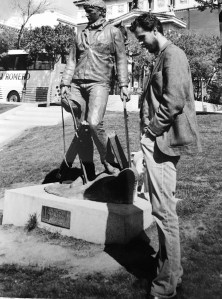
After having traveled to Spain he then decided to follow his heart to find a master who would be able to guide him in developing his work, and his heart brought him to Florence, Italy… A place where he lived for about a year, and which turned out to be the place where John Singer Sargent was born, and had thus seen his first light.
In Florence Ramón soon found the Charles H. Cecil studios, one of a number of academies in Florence which curriculum enthralled a program not very different from the 19th century Parisian ateliers. The studio had the sweet fragrance of oil of turpentine emitting from its classrooms and gave students the opportunity to work from live nude models and a beautiful collection of classical Roman sculptures. Ramon was invited by mister Cecil to spend some time with him in his private studio as he and a number of his students were painting some portraits from live models. Ramón accepted the honor and every day went to his studio in the early morning and absorbed the atmosphere and all there was to be seen. Eventually Ramón decided to stay true to his own inner calling. He decided not to enroll in the program but to follow his own artistic voice that was still yet to develop. Shortly after his return to The Netherlands he decided to start teaching the art of portraiture from his studio at the Haagdijk in his hometown of Breda, but this was something that he felt obscured his personal goals and he soon stopped and decided that is was time for a sort of closure from his period of searching and reminiscing. He thus decided to go to Spain and to travel in the footsteps of the young John Singer Sargent, who had also traveled there in the late 19th century in search of his master Diego de Velázquez. Ramón spend two years living in Madrid, and half a year in Granada in the south of Spain. In Granada he moved into an old house with a courtyard in the albaicin and soon learned that one of his housemates was the great-granddaughter of one of Sargent’s models. And that the portrait of her great grandfather was actually one of the very few portraits of Sargent which he himself had ever copied. Field Marshall Haig.
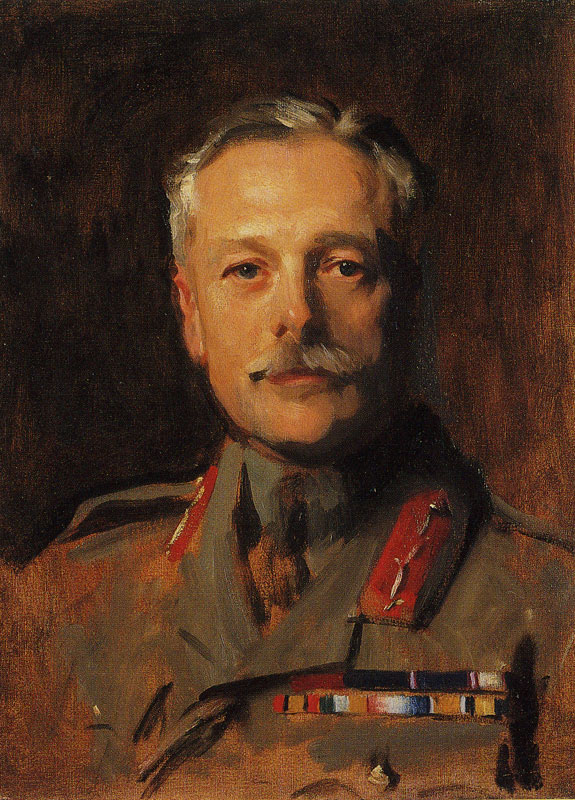
The other ones being the portraits of George Henschel which was displayed during one of my lectures on the latter in the Mesdag collection in The Hague, and the other a portrait of John D. Rockefeller which Ramón has donated to the Rockefeller Foundation in 2003 and has decorated their boardroom ever since. It was this chance encounter with the great granddaughter of Field Marshall Haig, that confirmed Ramón’s belief that he was heading in the right direction. Although he found it hard to paint in any of the places that Sargent has painted, as he felt that there was no point in painting what Sargent had already done… So instead of “painting” in Sargent’s footsteps, he decided to walk in them and to experience life as it would unfold to him in its own way. In Madrid he frequented the Prado museum on a daily basis, a place where he had been as a young man and where he had absorbed the Bohemian life on the streets of Madrid. Working as a waiter at night in the famous Madrileñan bar El Buscon, and painting during the day. A combination that after a certain time had caused him to become ill, and retire from his job, which in turn caused him to loose his income and necessitated him to go home to The Netherlands once again.
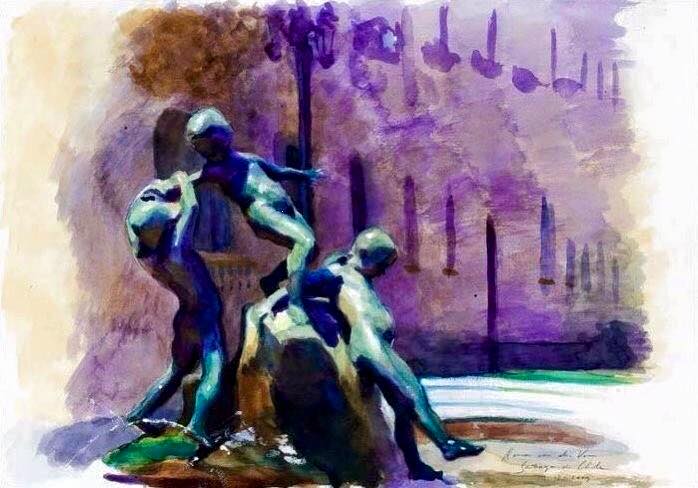
After a short period of being in The Netherlands where he recuperated from his illness, a severe case of sinusitis, he managed to work a bit and saved to travel to Chile in South America where he had previously been in 2003, and which’ beauty had moved him to wanting to go back there and paint. Ramón lived in Chile for about a year and mainly focused on the development of his watercolors of which one: The Fountain is included in this essay.
In 2011 Ramón had his first exhibition: The Pupil, dedicated to the artist John Singer Sargent. The exhibition was held at the Gallery on the corner in London. It’s title “The Pupil” was inspired by a novel of the American Novelist Henry James, which is based on the early childhood of the young and gifted John Singer Sargent.
The last few years Ramón has started to develop his own style through working on his landscapes out in the fields on a daily basis. Ramón only (without exception) works from life, and has made it his goal to let his artistic talents grow as naturally as possible… His colors are getting brighter, his brushwork more bold and confident, his contrasts enhance and in turn his early “impressionistic” brush strokes give way to a dance of bright and mesmerizing colors. He has mastered his deep and thorough understanding of his craft and again and again captures the light on his canvasses that sparkle with life and color.
Ramón’s work is a devotion to nature itself, however bold the brushstrokes or however swift he leaves his water-color marks on the paper (where his spontaneity is of a remarkably high caliber and his line work is exact to the point). Besides Painting and drawing Ramón has also started sculpting in clay, and is in particular drawn to the 19th century French sculptor, Jean Baptiste Carpeaux on which Ramón’s first bust, a portrait of his mother he has left his clear marks.

During the last couple of years Ramón’s previously more realistic/naturalistic manner in painting has become more fluent in style, clearly displaying his now over the years strongly developed natural abilities. All his work is painted from life – en plein air as one would say – and it clearly gives way to the direct experience of ones being in direct contact with nature itself. He works on large canvasses and often travels long miles on his bicycle through the Dutch countrysides and forests in search of inspiration. All of his landscapes are practically finished in one session (of sometimes no more then and hour!) and he never adds or retouches anything on return to his studio as he wants to leave his direct and spontaneous reaction to nature as pure as possible as experienced by him during the creation of his works in the field. The paintings he has made abroad in the Austrian and Swiss Alps sparkle with life and color and are rich in tonal values and contrast.
His numerous followers follow him on his artistic journey with great interest as he ventures into his passion with an even greater sense of boldness in his handling of colors, keeping his compositions strong and his line work full of schwung. I am also eagerly awaiting and anticipating for this young man’s fledgling, artistic career to unfold as he embarks on his new journeys, that above all, hold a great promise for the future as an artist and as a human being.
Edwin Becker
Chief Curator Van Gogh Museum, Amsterdam – The Netherlands
 Vanderven Foundation